Select a Language |
Close |
In the manner of GILLOWS OF LANCASTER & LONDON (1730-1903)
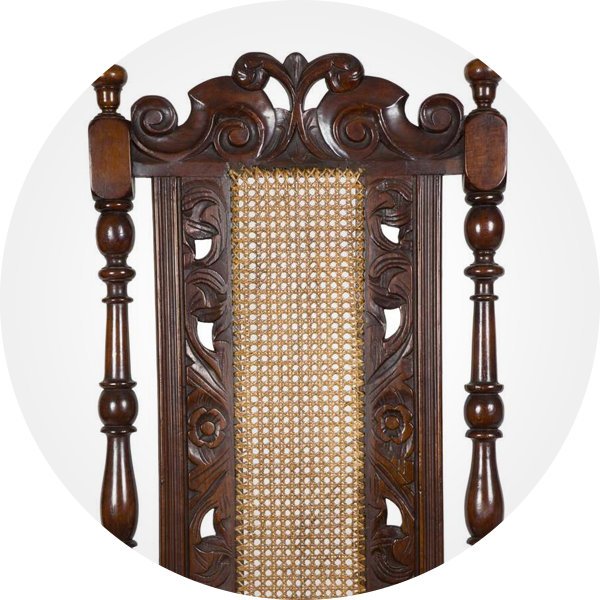
Pair of Regency Carver Arm Chairs (c. 1815 England)
|
|
|
|
|
|
|
| Item Medium Description |
mahogany |
||||||||
| UK/USA Dimensions |
21.50 inch wide 33.50 inch high 21.50 inch deep |
||||||||
| European Converted Dimensions |
54.61 cm wide 85.09 cm high 54.61 cm deep |
||||||||
| Current Item Condition |
Good Condition, tapestry seat covers replaced |
||||||||
| Item Description / Dealer Expertise |
A good pair of early 19th century mahogany arm chairs with reeded vertical rail backs and drop-in seats with modern tapestry seats. Standing on turned tapering legs, the arms with leaf-carved capitals and reeded rests raised on turned supports. |
||||||||
| GILLOWS OF LANCASTER & LONDON |
Furniture makers: In about 1695 Robert Gillow founded his firm in Lancaster. His son, Richard, was taken into partnership in 1757. The firm opened a London branch in Oxford Street about 1777.
Noble commissions came and in 1800, Richard Gillows took over a patent for an extending dining table which further enhanced the firm's reputation. The history of Gillows is exceptionally complete, as nearly all the order books and salesman's archives still exist. We know that the practice of stamping GILLOWS. LANCASTER started in around 1780 and continued until 1817, which might seem surprisingly early as the design seems to reflect the taste of the early Victorian era, yet it is twenty to thirty years ahead of its time. Today, it is difficult to comprehend the range of Gillows' business at this time. They traded not only in finished furniture, but also in timber from the West Indies along with sugar and spirits from the same region. They undertook architectural joinery and fitted out entire buildings, providing wall papers, fixtures and fittings. Their salesmen toured the country with books of illustrations lavishly coloured to tempt buyers. Gilllows even pioneered 'flat-packing' in order to offer their clients a reduced price. There was no corner of the furniture trade they did not thoroughly exploit. Between 1780 and 1830, they were the furniture trade, leading in price, fashion and even work practices. |
||||||||
|
More information / Purchase this item |
Please email or call +44 (0)8443 350845 for more information or to purchase this item. |
||||||||
| Status |
FOR SALE |
|
|
|