OnlineGalleries.com Twitter Feed Follow OnlineGalleries.com on Facebook
Select Language
Dutch
English
Finnish
French
German
Greek
Italian
Portuguese
Spanish
Swedish

Select a Language

Close
Dutch
English
Finnish
French
German
Greek
Italian
Portuguese
Spanish
Swedish
Login

Refine Your Results

No more refinements

There are no further refinements available.

GILLOWS OF LANCASTER & London

Move up
Move down

Biography

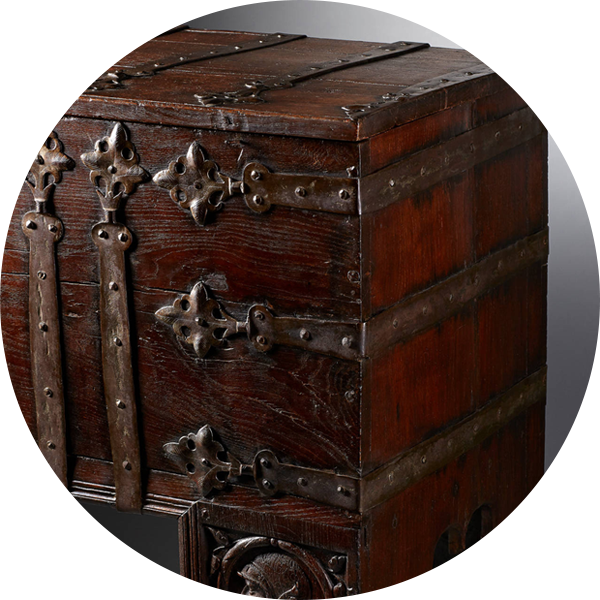
Furniture makers: In about 1695 Robert Gillow founded his firm in Lancaster. His son, Richard, was taken into partnership in 1757. The firm opened a London branch in Oxford Street about 1777.
Noble commissions came and in 1800, Richard Gillows took over a patent for an extending dining table which further enhanced the firm's reputation. The history of Gillows is exceptionally complete, as nearly all the order books and salesman's archives still exist. We know that the practice of stamping GILLOWS. LANCASTER started in around 1780 and continued until 1817, which might seem surprisingly early as the design seems to reflect the taste of the early Victorian era, yet it is twenty to thirty years ahead of its time.

Today, it is difficult to comprehend the range of Gillows' business at this time. They traded not only in finished furniture, but also in timber from the West Indies along with sugar and spirits from the same region. They undertook architectural joinery and fitted out entire buildings, providing wall papers, fixtures and fittings. Their salesmen toured the country with books of illustrations lavishly coloured to tempt buyers. Gilllows even pioneered 'flat-packing' in order to offer their clients a reduced price. There was no corner of the furniture trade they did not thoroughly exploit. Between 1780 and 1830, they were the furniture trade, leading in price, fashion and even work practices.

The text of this page is available for modification and reuse under the terms of the Creative Commons Attribution-Sharealike 3.0 Unported License and the GNU Free Documentation License (unversioned, with no invariant sections, front-cover texts, or back-cover texts).